Atlas
Good data in.
Fewer surprises out.A controlled path from supplier CSV to a reviewable import. Built to surface data problems before they reach the next system.
The brief
Supplier files can contain duplicate identifiers, missing fields and inconsistent values. A useful import tool must make those problems visible and preserve a clear route back to each source record.
The approach
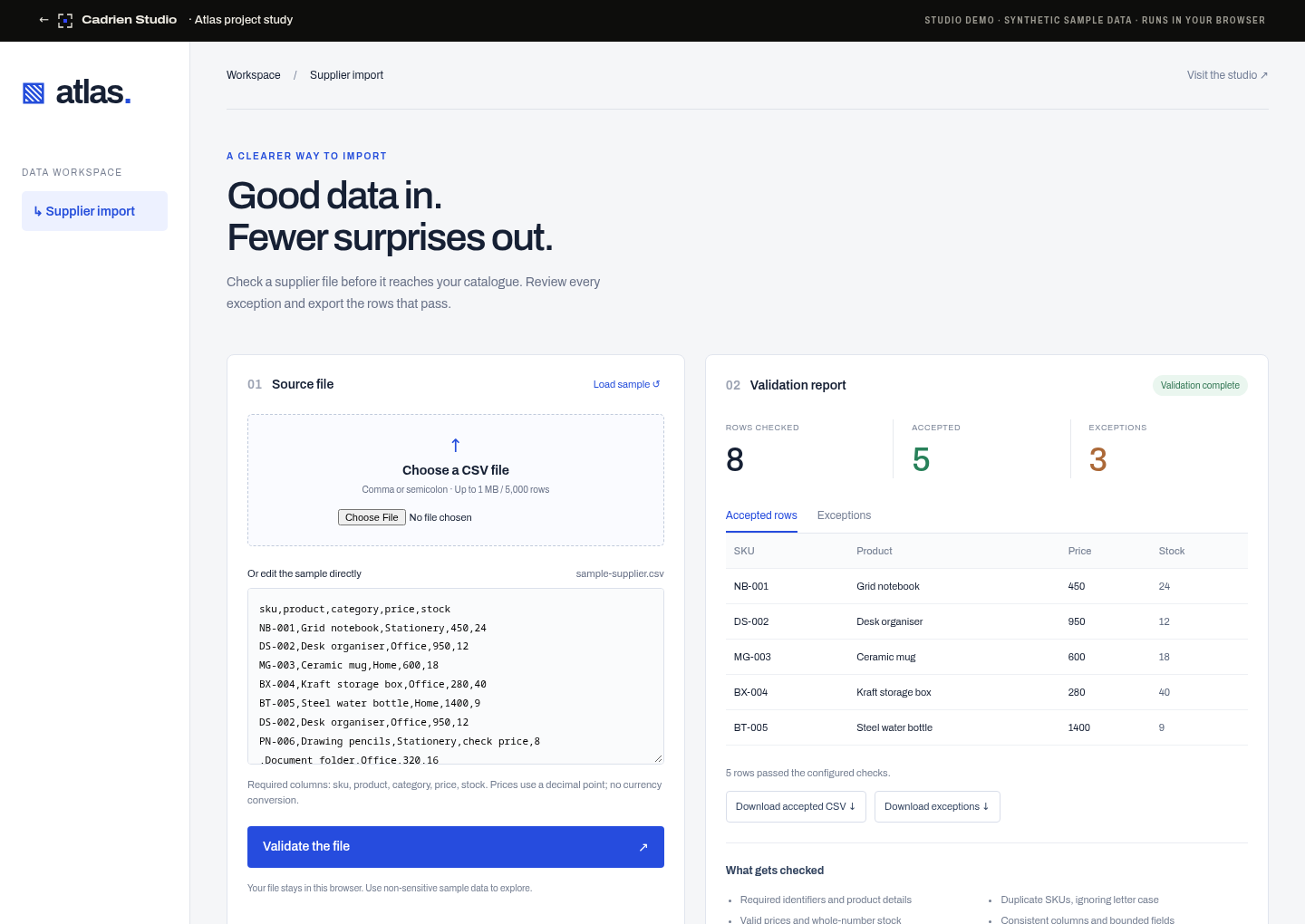
Atlas separates validation from export. Load a sample or a local CSV, inspect accepted records and exceptions, then download each result separately. Explicit rules make the decision understandable; editing the source disables export until it is checked again.
What you can verify
- Eight sample records produce five accepted rows and three exceptions.
- Duplicate SKUs, missing product details and invalid prices or stock are flagged.
- Quoted fields, escaped quotes, UTF-8 text and comma or semicolon delimiters are parsed.
- Exports contain the accepted data or the source record and exception reasons.
- Files are processed locally; the page sends no data to a server.
Implementation & handoff
The implementation separates the CSV parser and validator from the interface. The source includes automated checks for malformed files, limits, duplicate detection and spreadsheet-formula escaping. Browser checks cover loading, editing, reports and actual downloaded exports.
Honest context
An original Cadrien Studio software project using synthetic supplier data; not a customer commission. This version supports a defined five-column schema, files up to 1 MB and 5,000 records. It does not connect to a live store or database. A client integration would have its own mapping, access and acceptance requirements.